
DMIT
What is the relationship between Fingerprints and the Human Brain?
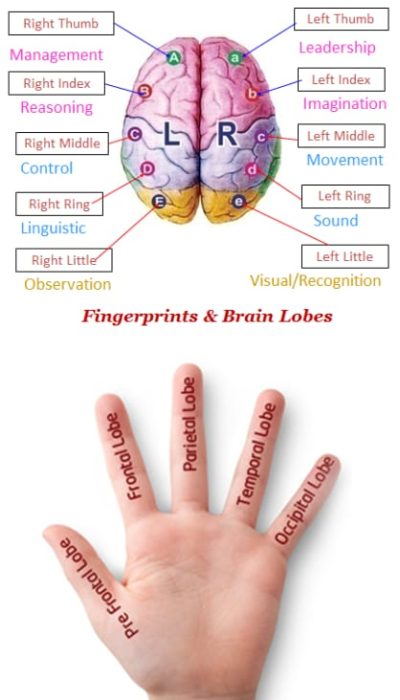
Fingerprints and the brain are connected because they both start to develop before we are born. Here’s how it works.
In short, our fingerprints can give us clues about our brains and what we might excel in.
When a baby is in the womb, both the skin and the brain are forming. The way the skin folds creates unique patterns for each person's fingerprints.
These patterns are influenced by genetics (the traits we inherit from our parents) and environmental factors (like how the baby moves in the womb).
Research suggests that certain fingerprint patterns might relate to different ways our brains work. For example:
- Some people with specific patterns might be better at solving problems.
- Others might be more creative or good with languages.
- Some people are very good at memorization and learning.
This connection means that by looking at someone’s fingerprints,
we might get hints about their strengths and how they learn best. It’s like a map that helps explain what they might be good at in life.
Benefits of DMIT ?
- DMIT test helps in understanding Multiple intelligences.
- Understanding individual personality behaviour and thought process.
- DMIT test tells which part of the brain is more dominant.
- Identify the correct learning style that makes your study process more productive.
- DMIT helps in exploring individual's direction of interest, area of strength and weaknesses and how to overcome from it.
- Reduce wastage of time, money and effort over irrelevant courses and classes.
- DMIT helps in selecting an educational stream that is best suited to your abilities, potential and desired career path.
- DMIT test helps in finding your hidden talents and improves your confidence.
- DMIT test helps in knowing the most compatible acquiring style of a person.
- DMIT helps to improve the parent-child relationship.
Benefits of DMIT ?
- DMIT test helps in understanding Multiple intelligences.
- Identify the correct learning style that makes your study process more productive.
- DMIT helps in exploring individual’s direction of interest, area of strength and weaknesses and how to overcome from it.
- DMIT test tells which part of the brain is more dominant.
- Understanding individual personality behaviour and thought process.
- Reduce wastage of time, money and effort over irrelevant courses and classes.
- DMIT helps in selecting an educational stream that is best suited to your abilities, potential and desired career path.
- DMIT test helps in finding your hidden talents and improves your confidence.
- DMIT test helps in knowing the most compatible acquiring style of a person.
- DMIT helps to improve the parent-child relationship.
History of Dermatoglyphics?
Ancient Use
People in ancient China and India used fingerprints for sealing documents and identifying individuals.
19th Century
In the late 1800s, scientists like Sir Francis Galton and Edward Henry studied fingerprints, proving they are unique to each person and don't change over time.
Early 20th Century
In the early 1900s, Juan Vucetich and Edward Henry began using fingerprints for criminal identification, making it an important tool in law enforcement.
Mid-20th Century
Researchers started linking fingerprint patterns to personality traits and learning abilities.
Today
Dermatoglyphics is used in forensics, education, and psychology to help understand individual strengths based on fingerprints.